RESEARCH PROJECT

PN-IV-P7-7.1-PED-2024-0091

English | Romanian

Phase I

03 January 2025 – 31 December 2025
Optimization of combustion-assisted digestion and μ-SPE using C18 silica-based sorbents or functionalized mesoporous silica sorbents for the extraction/preconcentration of elements, and testing the analytical applicability of the SSETV-μCCP-OES demonstrator at TRL3 level for ex-situ and on-site analytical procedures. Validation, characterization, and improvement of the analytical performance of SSETV-μCCP-OES-based methods with and without µ-SPE preconcentration ex-situ and on-site for food and environmental quality control through single-element or simultaneous multi-element determinations. (partial completion)
Combustion-assisted digestion scheme
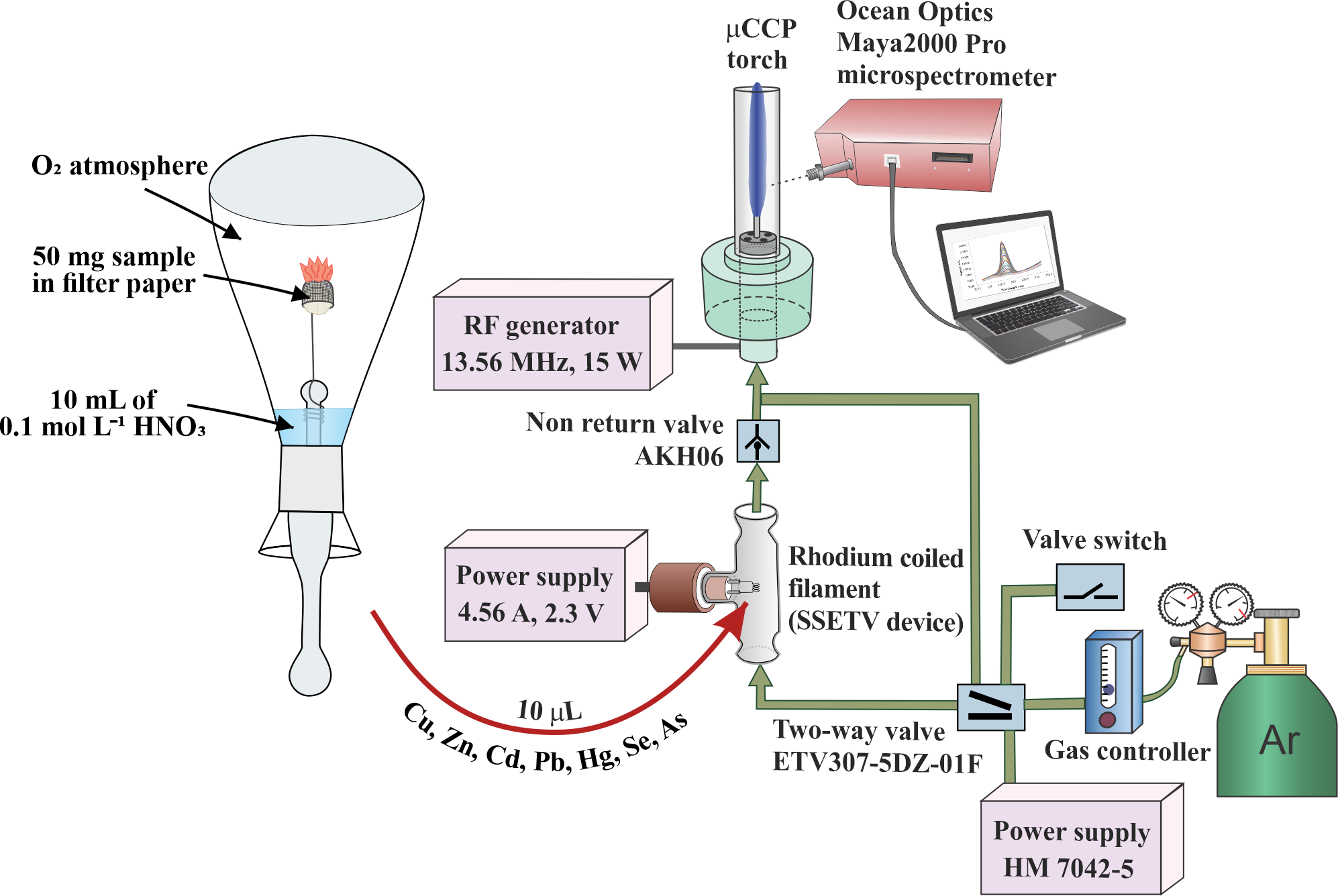
Principle of the combustion-assisted sample digestion method coupled with multielement determination by capacitively coupled plasma microtorch optical emission spectrometry with a miniaturized electrothermal vaporizer for microsample introduction (OFC-SSETV-µCCP-OES), at TRL4 technology readiness level. The food sample is dissolved by oxygen flask combustion, followed by Cd, Pb, Zn, Cu, Hg, Se and As simultaneous determination. The method was validated with detection limits between 0.01 and 1.20 mg kg⁻¹ and recoveries of 90–113%. The virtually energy-free sample preparation, the low reagent consumption and the miniaturized instrumentation provide a greenness degree of 77% and a whiteness degree of 93% compared with conventional microwave-assisted digestion coupled with inductively coupled plasma optical emission spectrometry (ICP-OES).

Phase II

01 January 2026 – 31 December 2026
Validation, characterization, and improvement of the analytical performance of SSETV-μCCP-OES-based methods with and without ex-situ and on-site µ-SPE preconcentration for food and environmental quality control by single element or simultaneous multielement determinations. Greenness and whiteness degree characterization, and broadening of the applicability of validated single element and multielement SSETV-μCCP-OES methods with and without ex-situ/in-situ preconcentration, through demonstration of their utility and capability on real samples.
Graphical abstract - Talanta paper: micro-SPE preconcentration
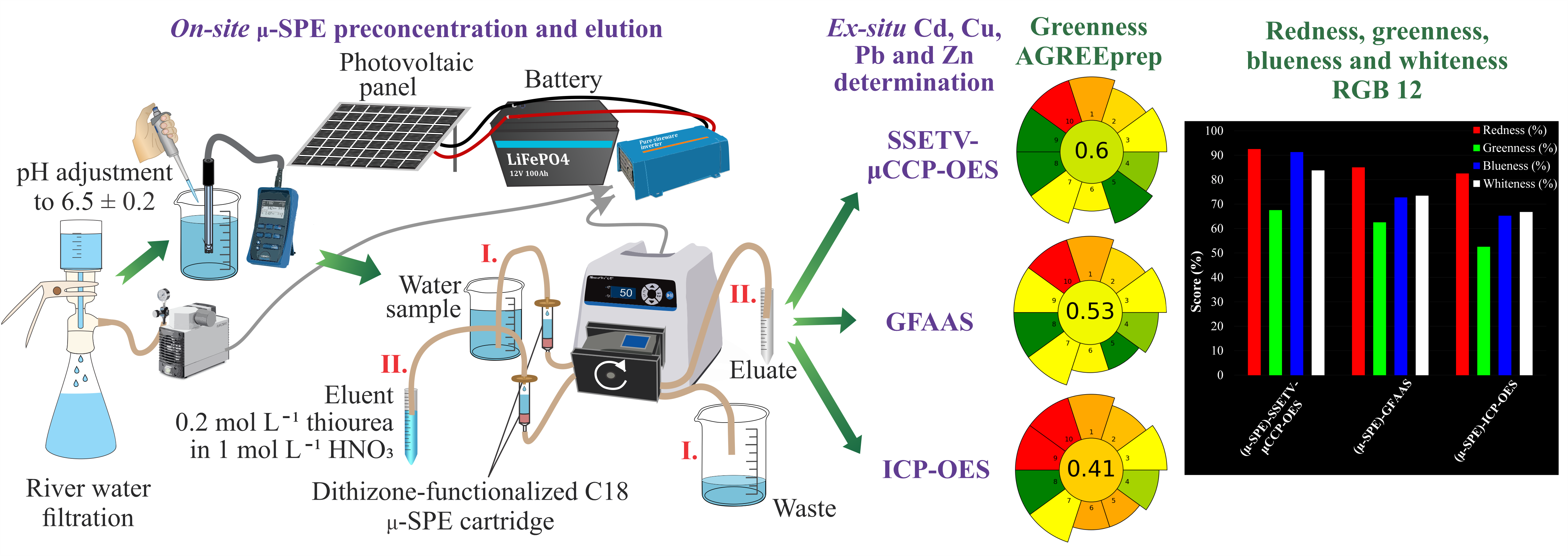
Portable tandem system combining on-site micro-solid phase extraction with optical emission spectrometry in the capacitively coupled plasma microtorch equipped with a miniaturized electrothermal vaporizer (μ-SPE-SSETV-μCCP-OES) for the simultaneous determination of Cd, Cu, Pb and Zn in surface water samples. The portable tandem is powered from a photovoltaic cell-charged battery, with an energy autonomy of 7.5 h. The water sample is processed on-site by preconcentration on a dithizone-functionalized C18 cartridge, followed by elution in a solution of 0.2 mol L⁻¹ thiourea in 1 mol L⁻¹ HNO3, and the eluate is then analysed. The method, at TRL4 technology readiness level, was validated for river water analysis, with improved detection limits of 0.4–3.5 ng L⁻¹ and recoveries of 91–108%. Portability, energy autonomy in the field and the miniaturized SSETV-µCCP-OES instrumentation provide a greenness degree of 60% and a whiteness degree of 84%, superior to the traditional methods — graphite furnace atomic absorption spectrometry (GFAAS) and inductively coupled plasma optical emission spectrometry (ICP-OES).

Project objectives

planned / achieved

General objective

1
General objective
✓ ACHIEVED

Planned objective

Increasing the technology readiness level of the fully miniaturized analytical system based on optical emission spectrometry in a capacitively coupled plasma microtorch with a low-resolution spectrometer and sample introduction by electrothermal vaporization using a miniaturized vaporizer (SSETV-µCCP-OES) from TRL3 to TRL4, through the development and validation of methods with a high greenness and whiteness degree and broad applicability in environmental and food quality control, by determining several elements of wide interest (Hg, Cd, Pb, Cu, Zn, As, Se), using the direct introduction of liquid microsamples by electrothermal vaporization after combustion-assisted digestion, with or without preconcentration by micro-solid phase extraction (µ-SPE) and separation of the analytes from the sample matrix.

Achieved objective

The technology readiness level of the SSETV-µCCP-OES laboratory equipment was raised from TRL3 to TRL4 through the development and validation of 3 new ex-situ/on-site microanalytical methods with a high greenness and whiteness degree for food and environmental quality control (surface water and soil quality control) by determining the elements of interest (Hg, Cd, Pb, As, Se, Cu and Zn) using the direct introduction of liquid microsamples by electrothermal vaporization into the microplasma, after combustion-assisted digestion for food, without preconcentration, and water processed on-site by µ-SPE with preconcentration on a dithizone-functionalized C18 cartridge implemented in a portable, energy-autonomous assembly powered from a photovoltaic cell-charged battery, respectively of an ex-situ method for the simultaneous determination of As-Cd in soil and sediments without separation from the sample matrix, after the mathematical correction of the As-Cd spectral interference, which cannot be resolved by the microspectrometer.
Specific objectives

1
Specific objective 1
✓ ACHIEVED

Planned objective

Optimization of the combustion-assisted digestion and of the µ-SPE with sorbents based on C18 silica or functionalized mesoporous silica for the extraction/preconcentration of the elements and testing of the analytical applicability of the TRL3 SSETV-µCCP-OES demonstrator for ex-situ and on-site analytical procedures.

Achieved objective

  • Report on the optimization of the oxygen combustion-assisted digestion of food samples, based on the residual organic carbon content in solution and in the combusted sample;
  • Report on the optimization of the extraction/preconcentration of elements from water samples on a dithizone-functionalized C18 cartridge or on functionalized mesoporous silica;
  • Report on the testing of the analytical applicability of the TRL3 SSETV-μCCP-OES demonstrator on real food and environmental samples (water and soil) for ex-situ and on-site analytical procedures at TRL4 level.
2
Specific objective 2
✓ ACHIEVED

Planned objective

Validation, characterization and improvement of the analytical performance of the SSETV-µCCP-OES-based methods with and without ex-situ and on-site µ-SPE preconcentration for food and environmental quality control through single-element determination or simultaneous multielement determination.

Achieved objective

  • Report on the validation and characterization of the new SSETV-μCCP-OES methods with and without ex-situ/on-site preconcentration for the determination of Hg, Cd, Pb, Cu, Zn, As, Se in food, Cd, Cu, Pb and Zn in surface waters, As and Cd in soil and water sediments, applicable in food and environmental quality control;
  • Report on the improvement of the analytical performance (sensitivity and detection limits) of the new SSETV-µCCP-OES methods by integrating the transient analytical signal along the spectral line profile and by applying µ-SPE preconcentration;
  • Report on the validation of the new OFC-SSETV-µCCP-OES methods for the determination of Hg, Cd, Pb, Cu, Zn, As, Se in food and of Cd, Cu, Pb and Zn in surface waters, by comparison with the traditional ICP-OES and GFAAS methods.
3
Specific objective 3
✓ ACHIEVED

Planned objective

Characterization of the greenness and whiteness degree and extension of the applicability of the single-element or multielement methods validated on SSETV-µCCP-OES with and without ex-situ/on-site µ-SPE preconcentration, and through the demonstration of the utility and capacity on real samples.

Achieved objective

  • Report on the assessment of the greenness and whiteness degree using the AGREEprep and RGB-12 metrics for the new ex-situ OFC-SSETV-µCCP-OES method for food with combustion-assisted digestion and the on-site µ-SPE-SSETV-µCCP-OES method for water samples, by comparison with the traditional laboratory ICP-OES method and the traditional sample preparation by microwave-assisted digestion;
  • Experimental report on the applicability extension of the new OFC-SSETV-µCCP-OES methods for food and µ-SPE-SSETV-µCCP-OES methods for the environment, in comparison with ICP-OES and GFAAS;
  • Demonstration and presentation activity of the utility and capability of the new methods, organized for invited potential users, and demonstration report;
  • Patent application filed, entitled Portable assembly powered from a photovoltaic cell-charged battery for the on-site processing of surface water samples by micro-solid phase extraction for the determination of the toxic metal content by spectral methods (OSIM application number ....).